A vehicle classifier should not be accepted from one overall accuracy number. The agency must define the class scheme, create an independent time-synchronized truth set, sample lanes and operating conditions, report a confusion matrix and unknowns, expose rare-class uncertainty, and preserve the configuration and data needed to reproduce the score.
Table of Contents
Declare the Classification Scheme and Use
State whether the program needs the FHWA 13-category scheme, a length-based grouping, a local planning schema, tolling classes, axle classes, or another controlled definition. List each class, boundary, unknown/other label, excluded case, and how the data will be used.
FHWA notes that its standard 13 vehicle types support applications including design, safety analysis, performance measurement, and environmental analysis. A local sensor may measure length or another signature, then map that observation to the required class. Document that mapping.
Freeze sensor, mount, lanes, zones, firmware, analytics, thresholds, schema version, time source, and export format before scoring.
Build an Independent and Reviewable Truth Set
Choose a reference method appropriate to the site and class definition. Time-synchronized reviewed video is common for visual truth; axle-based classification may require a suitable reference sensor or carefully designed study. Keep the reference independent from the system being evaluated.
Define reviewer training, labeling instructions, minimum visible evidence, disagreement resolution, blind review, time matching, unknown labels, duplicate/missed vehicle treatment, and data privacy. Preserve a truth manifest and immutable source IDs.
FHWA describes manual methods as costly but important for verifying automated detection equipment. Do not let the installer edit truth labels to improve alignment without a logged adjudication process.
Sample the Conditions That Produce Errors
| Sampling slice | Why report it separately | Typical ambiguity to examine |
|---|---|---|
| True vehicle class | Prevents dominant classes from hiding weak ones | Adjacent length or axle classes |
| Lane and sensor range | Exposes geometry and occlusion differences | Far-lane loss or spillover |
| Speed/traffic state | Shows stop-and-go or close-following effects | Merged or split observations |
| Day/night and lighting | Tests video or fusion components | Headlights, shadows and glare |
| Weather/road surface | Tests signal and visibility changes | Spray, precipitation or deposits |
| Turns/lane changes | Tests association to one lane and direction | Double count or class swap |
| Small sample classes | Exposes uncertainty | Unsupported confidence from few vehicles |
Collect enough of each decision-relevant slice to support the intended conclusion. When a class is rare, report the sample and uncertainty rather than claiming the overall score applies equally.
Report a Confusion Matrix, Unknowns, and Detection Errors
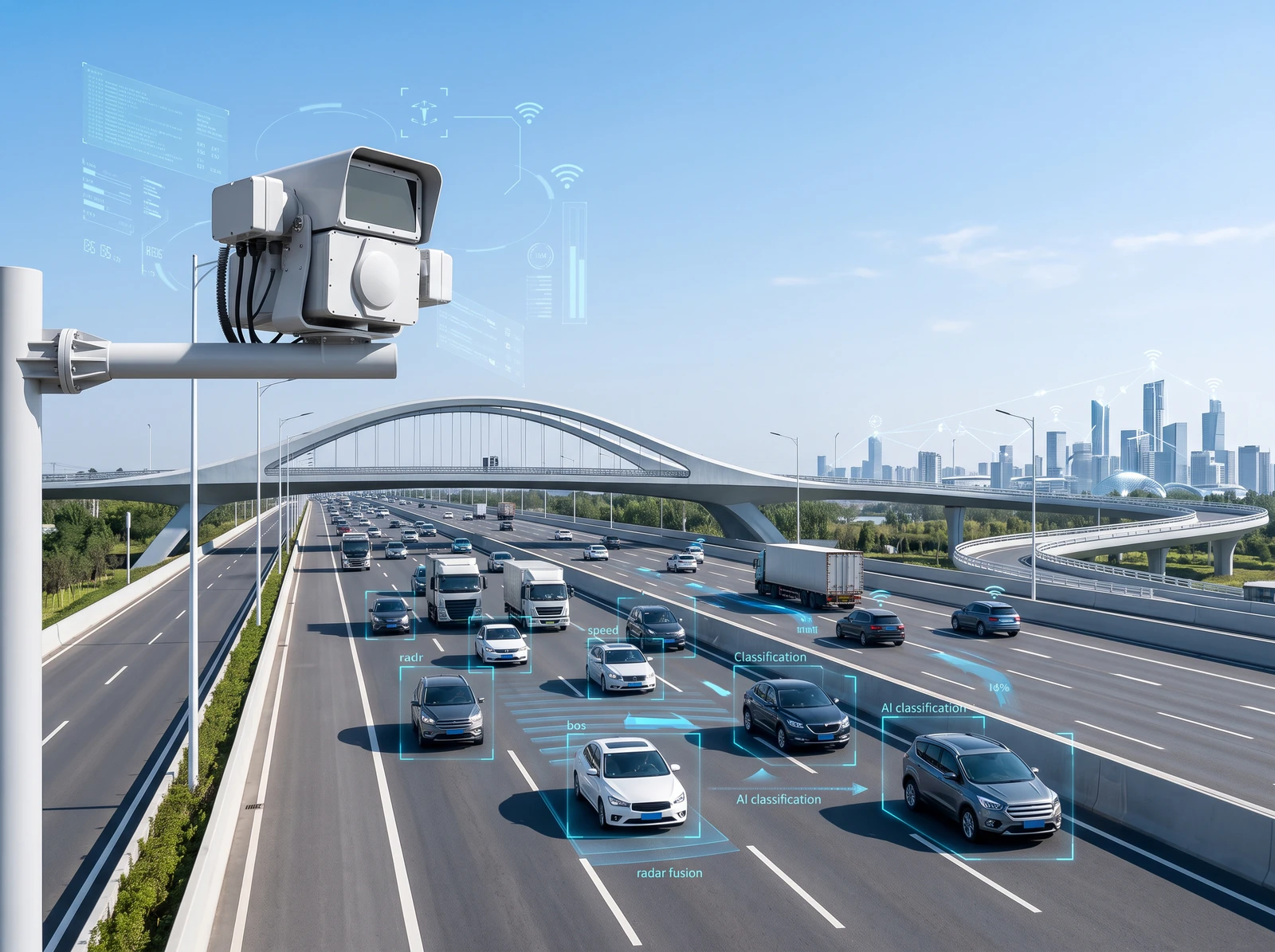
Create a matrix with true classes as one dimension and predicted classes as the other. Report per-class recall, precision where useful, total support, and unknown/unclassified outcomes. Keep missed detections, false vehicles, duplicates, wrong lane, and wrong direction separate from class confusion.
An overall percentage can be included, but it should not replace the matrix. Show whether a class result is based on five examples or five thousand. State the time-matching rule and how close-following vehicles were associated.
FHWA’s methodology guidance recommends regular calibration and testing and points to established test methods for traffic monitoring devices and vehicle classification. Use current agency requirements and the exact technology under evaluation.
Investigate Errors Before Tuning
Trace errors to truth ambiguity, zone geometry, occlusion, sensor alignment, class boundary, speed estimate, axle detection, close following, trailer association, lane change, glare, precipitation, dirty optics, network loss, clock offset, or software behavior. Correct the cause and version the change.
Rerun a fixed regression set after tuning. Do not improve the test set through repeated manual adjustment and then report it as independent performance. Reserve a blind or later sample for confirmation.
The vehicle detection-zone guide helps isolate geometric and event errors before class scoring. The traffic-sensor calibration guide turns the accepted truth method into periodic QA.
Establish Ongoing Data-Quality Checks
Monitor missing intervals, implausible class distributions, abrupt lane differences, unknown growth, clock drift, zero/stuck values, configuration change, and divergence from periodic manual or reference samples. Define investigation and retest triggers.
Evaluate the TRVF-8221-SCO flow detector and TRVF-8221 radar-video sensor against the declared schema. The smart-transportation portfolio, smart-city solution, and resource center support the truth and QA record.
FAQs
What is the FHWA vehicle classification scheme?
FHWA uses a standard 13-category vehicle classification scheme for many traffic-data applications, but projects must confirm whether axle-based, length-based, visual, or another approved schema is required.
Why is overall vehicle classification accuracy misleading?
A dominant passenger-car class can hide poor motorcycle, bus, or heavy-truck results. Accuracy should be reported by true class, predicted class, lane, speed, traffic state, and relevant condition.
How can vehicle classification ground truth be created?
Use an independent, time-synchronized and reviewable method such as approved video/manual labeling or a suitable reference array, with documented reviewers, ambiguity rules, sampling, and quality checks.